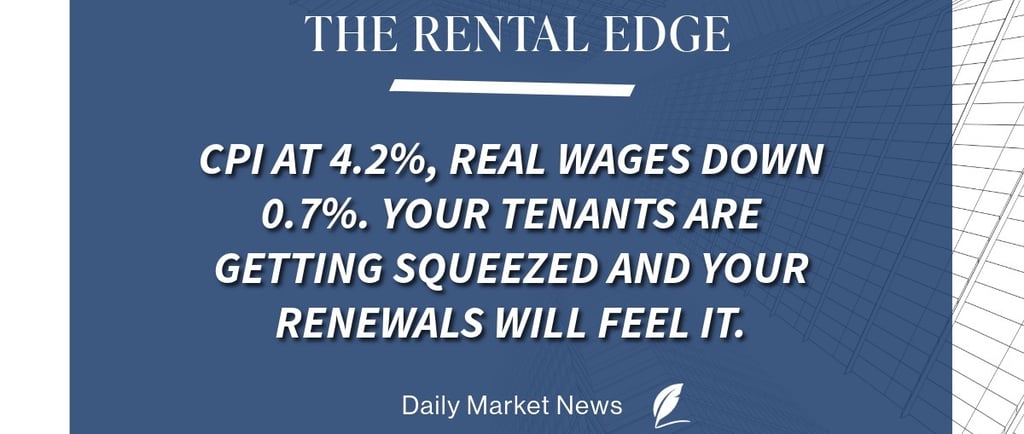
CPI at 4.2%, Real Wages Down 0.7%. Your Tenants Are Getting Squeezed and Your Renewals Will Feel It.
The purchasing power squeeze is back. The Bureau of Labor Statistics reported on June 10, 2026 that the Consumer Price Index rose 4.2% year over year in May 2026, up from 3.8% in April and the fastest annual inflation rate recorded since April 2023.
6/11/20263 min read
The purchasing power squeeze is back. The Bureau of Labor Statistics reported on June 10, 2026 that the Consumer Price Index rose 4.2% year over year in May 2026, up from 3.8% in April and the fastest annual inflation rate recorded since April 2023. At the same time, real average hourly earnings for all employees fell 0.1% month over month and real average weekly earnings dropped 0.2%. For rental investors tracking inflation and wage growth, the signal is clear: household budgets are under renewed pressure, and the gap between what renters earn and what they owe is widening again.
What the June 10 BLS Data Actually Shows
The headline numbers from the BLS Real Earnings and CPI releases tell a story that goes beyond a single month's print. On an annual basis, real average hourly earnings fell 0.7% from May 2025 to May 2026, while real average weekly earnings fell 0.4% over the same period. Reuters confirmed the May 2026 CPI reading of 4.2% represents the sharpest year over year acceleration in more than three years.
This is not a one month blip. Prices have been running ahead of paychecks throughout much of 2025 and 2026, a dynamic that USAFacts wage versus inflation analysis has tracked as a persistent structural challenge for working households. When nominal wage growth cannot keep pace with inflation, real purchasing power erodes regardless of how tight labor markets appear on the surface.
What Negative Real Wages Mean for Renters Right Now
The math is straightforward and it works against renters. A household earning $60,000 annually that saw wages rise 3% nominally this year effectively received a pay cut in real terms when inflation is running at 4.2%. That household has less discretionary income in May 2026 than it did a year ago, even if the number on the paycheck is higher.
For lower and middle income renters, this dynamic is especially sharp. United Way NCA rent versus wage analysis from January 2026 documented how rent costs in markets across the Southeast have been outpacing wage growth for multiple consecutive years, leaving renters with shrinking financial cushion. When inflation re-accelerates into that environment, the cushion gets thinner faster.
The Charlotte market illustrates the tension directly. CBS News coverage from May 2026 identified Charlotte as one of the metros where rents are rising faster than wages, with average rent sitting around $1,975 and year over year rent growth tracking near 4%. NC Commerce rental market analysis from June 2025 confirmed that demand fundamentals in Charlotte remain tight, but affordability constraints are becoming a more consistent drag on leasing velocity and renewal conversion.
What This Means For Rental Investors
1. The buy versus rent calculus still favors continued renting, but for budget reasons, not preference. Elevated mortgage rates and home prices keep ownership out of reach for a large share of the renter pool. That structural demand support is real. But investors should not mistake trapped renters for comfortable ones. Household budgets are under genuine stress, and that stress shows up in renewal negotiations, payment patterns, and concession requests.
2. Underwrite to current incomes, not last year's rent momentum. In Southeast markets where rent growth has historically outpaced wages, MeCARealty's rental market analysis notes that operators who modeled renewals against 2024 or early 2025 income data are now facing a more price sensitive tenant base than their underwriting assumed. Run rent to income ratios against current BLS earnings data for your specific submarket before setting 2026 renewal pricing.
3. Lower and middle income segments carry elevated delinquency risk. When real wages fall for two or more consecutive quarters, payment stress tends to surface first in Class B and Class C assets. Operators in these segments should review lease expiration schedules, tighten communication cadences with residents, and ensure collections protocols are current before the next renewal cycle.
4. Aggressive rent increases will face faster resistance in 2026. The affordability gap in markets like Charlotte means renewal tenants have less room to absorb increases than they did in 2022 or 2023. A 4% to 6% renewal push that would have held two years ago may generate more turnover today. Modeling the true cost of a vacancy against a smaller increase is essential underwriting discipline in this environment.
The Bottom Line
Inflation re-accelerating to 4.2% while real wages decline is not a macro abstraction. It is a direct input into tenant behavior, renewal outcomes, and portfolio performance. The rental investor who monitors inflation and wage growth data alongside their local rent metrics will have an edge over those who rely on lagging market reports alone.
Follow The Rental Edge for daily data driven updates on the numbers that move rental markets. We track the BLS releases, regional wage trends, and local market signals so you can underwrite with clarity and act with confidence.
Sources: Bureau of Labor Statistics Real Earnings Release, June 10, 2026; Bureau of Labor Statistics Consumer Price Index Release, June 10, 2026; Reuters CPI coverage, June 10, 2026; USAFacts wage versus inflation analysis, March 2025; United Way NCA rent versus wage analysis, January 2026; NC Commerce rental market analysis, June 2025; MeCARealty rental market analysis; CBS News Charlotte rent coverage, May 2026.